
Tuskar Rock Lighthouse Replica – A Labour of Love
When the Rosslare Municipal District commissioned Damien McAleenan of Briteweld in Glynn to complete a replica of the iconic Tuskar Rock lighthouse there was no way they could have foreseen the passion, devotion and respect for the story of Tuskar Rock that Damien would bring to the project and to the replica now sited on the newly named Tuskar Rock roundabout. We asked Damien to tell us the story behind his creation and this is what he had to say:
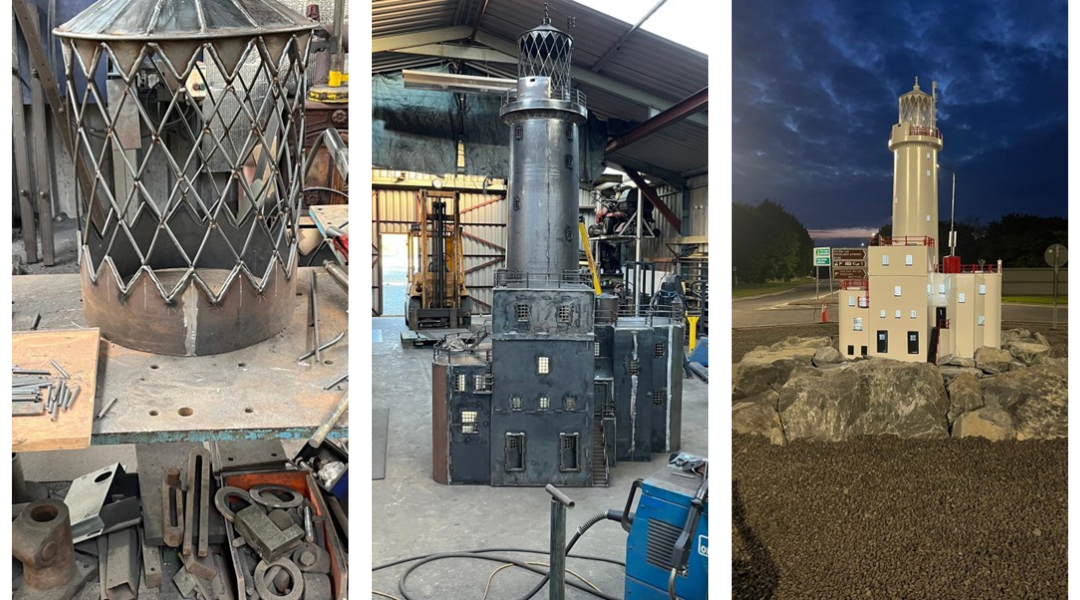
After weeks of researching the structure of Tuskar, completing and refining drawings and scaling, I started work on the top section, the light tower. I was determined to develop the replica in as much detail as possible working from the top of the building to the base.
The sculpture took many weeks to complete, during which I worked from 5 in the morning till 9 at night. My wife, Suzanne, only allowed me to work 6 days on the project insisting I take the 7th day of rest! Suzanne shared my devotion for the project and helped from time to time and most importantly she kept the coffee cup full!
As part of my research into the history of Tuskar I linked up with Peter Goulding, a lighthouse enthusiast and historian and the creator of “Pete’s Lighthouse Blog” He provided me with some wonderful details of the history of Tuskar which prompted me to add specific features to recognise those who lost their lives on or close to the Tuskar Rock Lighthouse which include:
-
61 notches placed just under the light tower to commemorate the crew and passengers killed in the 1968 Aer Lingus Flight 712 (St Phelim) plane disaster near Tuskar Rock.
-
The number 15 engraved into one of the doors to commemorate the workers who died during the construction of the lighthouse in 1812/14, 14 in a storm and 1 who fell from the structure.
-
The number 1, engraved in the front door to commemorate the lightkeeper died following the collision and explosion of a floating war mine with the rock.
I mainly used photographs of the lighthouse to replicate the various features including the 27 windows, 4 doors, steps, handrails, handrail posts, inspection ladders and chimneys that exist on the lighthouse and then, to make sure I hadn’t missed anything I had the privilege of being allowed to visit Tuskar Lighthouse to do some final checks. It was a great experience to visit the lighthouse and get the feeling of complete isolation and how lonely and scary it can be out there during the rough weather. On my trip I got an actual light bulb from the lighthouse and was able to use it in the sculpture and it has added greatly to the reflection of light from the replica when it lights up at night.
The replica stands at 3.7m representing one tenth of the size of the original structure and the main body of the replica is crafted from rolled steel which I sourced from Crowley’s in Cork and Duggan’s steel Kilkenny. Galco Waterford undertook the intricate task of the hot dip galvanizing of the completed structure and local company Crosbie Bros completed the very professional and detailed painting work. I am grateful to these companies for the care and professional work they completed.
The lighthouse beam or “Characteristic” of Tuskar Lighthouse is captured by the night lighting of the sculpture. This is made possible by solar panels powering XXXX of light adding the final but essential element of what makes a lighthouse what it is.
I have dedicated my work on this sculpture to my wife and to my father who taught me a lot and I have done this by engraving their initials inside the sculpture - SMA Suzanne McAleenan and JMA James McAleenan. It was a great honour and privilege to construct the sculpture for the community and the county and I enjoyed every minute making it. We became so invested in the history, story and construction of the replica that my wife and I found it very hard to see it leave the workshop.
Damien McAleenan
July 2024.
SS Patrick Information
FORGOTTEN SINKING OF ROSSLARE FERRY
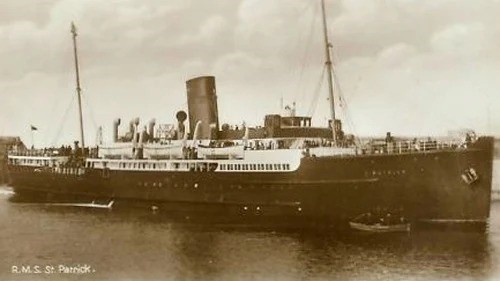
The Rosslare to Fishguard ferry SS St. Patrick II was targeted three times by the Luftwaffe in WWII. It was manned by a mostly Irish crew, and Mosey Brennan from Skeffington Street in Wexford town died from the first attack in 1940. In another assault on Friday 13 June 1941, the ship was sunk with the loss of 17 crew, a gunner and 12 passengers. Many of the dead were Irish and among them was Mosey’s son, 17-year-old deckboy John Brennan and Captain Faraday from Arthurstown and his 19-year-old son Jack. But the tragedy has been largely forgotten on this side of the Irish Sea.
(Extract from ‘Fascinating Wexford History - Volume Two’)
More information on the SS St Patrick can be found at the following links:
The Sinking of the St Patrick | Suddo’r St Patrick | Ports, Past and Present (information available in Welsh also)
The Sinking of the St Patrick | Suddo’r St Patrick
By | Gan Natasha de Chroustchoff
“TRAGEDY OF THE SEA” read the headline in North Pembrokeshire’s local newspaper, The County Echo, when it reported the destruction by enemy action of the Fishguard to Rosslare passenger and mail ferry the St Patrick with the loss of 28 lives. | “TRAGEDY OF THE SEA” meddai pennawd papur newydd lleol Sir Benfro, The County Echo, wrth nodi bod ymosodiad gan y gelyn wedi dinistrio’r fferi i deithwyr a phost rhwng Abergwaun a Rosslare, St Patrick, pan gollwyd 28 o fywydau.
The St Patrick was the only ferry still sailing between Ireland and Wales during World War Two. The others, the St David and the St Andrew, had been requisitioned as hospital ships serving the European front. The St. Patrick made a regular daily crossing of St. George’s Channel, protected from submarine attack by an extensive minefield to the south. The ship had however been twice strafed from the air and the previous year a Wexford sailor, Moses Brennan, had died following a machine gun wound.
Some of those who boarded in Wexford on the night of Friday June 13th, 1941 might have considered the date inauspicious, but the sea was calm and the ship was in the experienced hands of Captain Jim Faraday who expected to reach his home port of Fishguard soon after sunrise. Unusually, he had his Merchant Navy cadet son Jack with him ‘for the ride’ since he happened to be home on leave. The captain, like most of the crew, was a local man, but five were Irish, as were most of the passengers.
Twelve miles off Strumble Head, just as the summer dawn was breaking, the ship was targeted by a German Heinkel aeroplane which dropped a stick of four bombs amidships, destroying the saloon cabin and the bridge and igniting the fuel tanks. All but one of the first class passengers died instantly as did the captain and his senior officers. The burning ship broke in two and sank in minutes. The surviving crew launched a lifeboat and a raft and did their utmost to save the remaining 43 passengers most of whom were floundering in the oily water.
Of the two stewardesses, one had been killed outright, leaving only 41-year-old May Owen to evacuate the women and children. May refused to leave the sinking ship until all her charges were in life jackets, and even at the last moment she went below again to assist a passenger. She then supported a woman and a girl in the water for two hours before being picked up by a rescue vessel.
Second engineer Frank Purcell bravely went down into the burning ship to save three men trapped in the engine room. He found a fourth lying injured in a passageway, brought him on deck and supported him in the water until they could be rescued.
The radio operator, Norman Campbell, remained at his post below decks until the bitter end using emergency equipment to signal for help. As a result of his courage and presence of mind he was able to alert nearby ships, which raced to the scene. The surviving passengers and crew were plucked from the sea and taken to Milford Haven. By the time the Fishguard lifeboat reached the spot nothing was visible apart from a couple of fish boxes floating among the bubbles.
These three crew members, all residents of Fishguard and Goodwick, were later honoured for their courage. Frank Purcell and Norman Campbell received the Order of the British Empire while May Owen was awarded the George Medal for gallantry. She returned to work as a stewardess and lived out her life quietly, with few knowing of her heroism. She married but had no children, and is buried in a peaceful windswept cemetery high above her home town within sight of the sea and of Strumble Head, not so far from where the St Patrick lies on the seabed. The small initials G.M. after her name are barely noticeable.
By strange coincidence, two parallel father-son tragedies are associated with the loss of the St Patrick, mirroring one another across the water as if to highlight the fragility of sea-going lives.
Captain Faraday’s 19-year-old son Jack, although not officially a crew member, was a strong swimmer and worked tirelessly to rescue people from the water but, finding his father not among them, went back to look for him. He was not seen again. His brother later joined the air force to seek vengeance and also lost his life.
The youngest crew member on the St Patrick, deck boy Michael John Brennan, aged 17, was the son of the Wexford sailor who died from injuries received in the previous enemy attack on the ship. The eldest of Moses Brennan’s seven children, John had gone to sea to support his family after his father’s death.
Following the sinking of the St Patrick, the close-knit communities of Wexford and Fishguard/Goodwick shared the pain of a loss that rippled out and touched so many in those wartime years – and which is not forgotten even now. Every Remembrance Day the current ferry pauses in its crossing and drops a wreath at the spot where the St Patrick went down.
___________________________________________________________________
Documentary On One: The Sinking of the Saint Patrick
1941-Sinking-of-St-Patrick.pdf
__________________________________________________________________
The sinking of the SS St Patrick 1941 – The Irish at War (text below)
The sinking of the SS St Patrick 1941
#OnThisDay 1941 The SS St. Patrick, was sank by the Luftwaffe 12 miles out from Fishguard port. The SS St Patrick was a passenger ferry on the Rosslare to Fishguard line. The German bombs hit the fuel tanks and the ship exploded in two. 30 of the 50 passengers were killed including 17 year old John Joe Brennan from Wexford. Brennan’s father Mosie died a year previous on the St Patrick when strafed by a German plane’s machine-guns.
The SS St Patrick was a joint owned ship, owned by Rosslare and Fishguard, but it sailed under a British ship which made it an enemy vessel in the eyes of a Luftwaffe pilot.
Another father and son to perish on the ship was the Captain Jim Faraday and his 20 year old son Jack. Jack had worked hard to save many of the passengers in the water but when he tried to rescue his father, both of them drowned.
__________________________________________________________________
WRECKSITE - ST. PATRICK PASSENGER SHIP 1930-1941
WRECK WRAK EPAVE WRACK PECIO (this website provides a list of the crew members who died onboard)